第11章图论-part04,今天的应用题,在图的存储和连接 上比岛屿问题难了。
110. 字符串接龙 1.1 解题分析
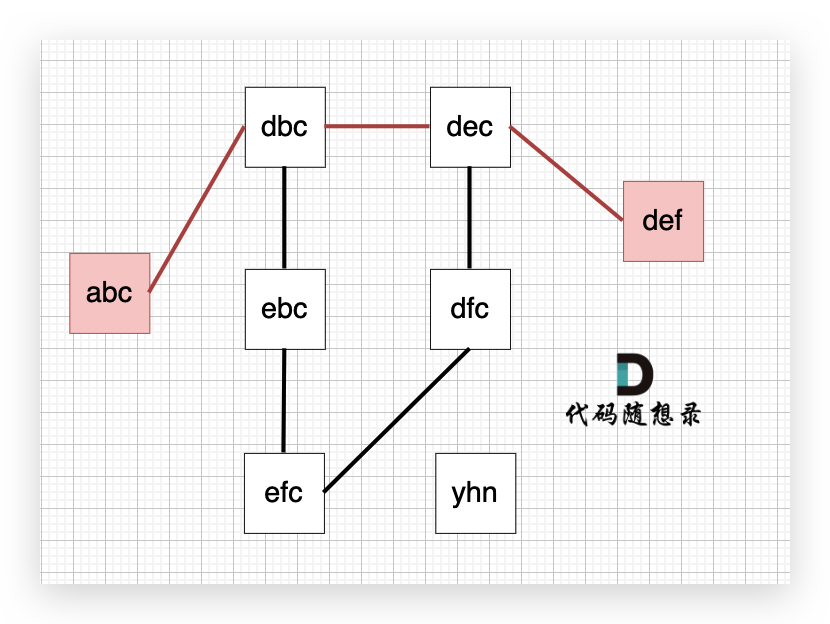
从 startStr 到 endStr,在 strList 中最短的路径为 abc -> dbc -> dec -> def,所以输出结果为 4。
本题的难点 有2个:
节点之间怎么连接在一起? 在搜索的过程中,我们可以枚举,用26个字母替换当前字符串的每一个字符,在看替换后 是否在 strList里出现过,就可以判断 两个字符串 是否是链接的。 起点和终点的最短路径长度怎么算? 在无权图中,求最短路,用深搜或者广搜就行,没必要用最短路算法。本题如果用深搜,会比较麻烦,要在到达终点的不同路径中选则一条最短路。 1.2 解题小结 1 2 3 4 5 6 7 8 9 10 11 12 13 14 15 16 17 18 19 20 21 22 23 24 25 26 27 28 29 30 31 32 33 34 35 36 37 38 39 40 41 42 43 44 45 46 47 48 49 50 import java.util.*;public class Main {public static void main (String[] args) {Scanner scanner = new Scanner (System.in);int n = scanner.nextInt();String beginStr = scanner.next();String endStr = scanner.next();new HashSet <>();while (n-- > 0 ) {private static void bfs (String beginStr, String endStr, Set<String> wordSet) {new ArrayDeque <>();new HashSet <>();new HashMap <>();1 );while (!queue.isEmpty()) {String curStr = queue.pollFirst();for (int i = 0 ; i < curStr.length(); i++) {StringBuilder cur = new StringBuilder (curStr);for (int j = 0 ; j < 26 ; j++) {char )(j + 'a' ));String newWord = cur.toString();if (newWord.equals(endStr)) {1 );return ;if (wordSet.contains(newWord) && !visited.contains(newWord)) {1 );0 );
105. 有向图的完全可达性 2.1 解题小结 都说递归伴随着回溯,但本题求图的可达性不需要回溯 ,找路径要回溯。
1
2
3
4
5
6
7
8
9
10
11
12
13
14
15
16
17
18
19
20
21
22
23
24
25
26
27
28
29
30
31
32
33
34
35
36
import java.util.*;public class Main {public static void main (String[] args) {Scanner scanner = new Scanner (System.in);int n = scanner.nextInt();int k = scanner.nextInt();boolean [] visited = new boolean [n + 1 ];new ArrayList <>(n + 1 );for (int i = 0 ; i < n + 1 ; i++) {new LinkedList <>());while (k-- > 0 ) {int s = scanner.nextInt();int t = scanner.nextInt();1 , visited);for (int i = 1 ; i < n + 1 ; i++) {if (!visited[i]) {1 );return ;1 );private static void dfs (List<LinkedList<Integer>> graph, int node, boolean [] visited) {if (visited[node]) return ;true ;for (int n : graph.get(node)) {
106.岛屿的周长 3.1 解题分析 遍历每一个空格,遇到岛屿则计算其上下左右的空格情况。
如果该陆地上下左右的空格是水域,则说明是一条边;如果该陆地上下左右的空格出界了,则说明是一条边。
3.2 解题小结 1 2 3 4 5 6 7 8 9 10 11 12 13 14 15 16 17 18 19 20 21 22 23 24 25 26 27 28 29 30 31 32 33 34 import java.util.*;public class Main {static int [][] dir = new int [][]{{0 , 1 }, {1 , 0 }, {0 , -1 }, {-1 , 0 }};public static void main (String[] args) {int res = 0 ;Scanner scanner = new Scanner (System.in);int n = scanner.nextInt();int m = scanner.nextInt();int [][] grid = new int [n][m];for (int i = 0 ; i < n; i++) {for (int j = 0 ; j < m; j++) {for (int i = 0 ; i < n; i++) {for (int j = 0 ; j < m; j++) {if (grid[i][j] == 1 ) {for (int k = 0 ; k < 4 ; k++) {int nearX = i + dir[k][0 ];int nearY = j + dir[k][1 ];if (nearX < 0 || nearX >= n || nearY < 0 || nearY >= m || grid[nearX][nearY] == 0 ) {
4. 今日收获